Showing posts with label Hindu American Seva Charities. Show all posts

Hello, America! The Hindus Are Here, And We’d Like to Help.


A confluence of events: recent Pew Research study that includes the Hindu-American community, and the upcoming White House conference we’re assisting with, Dharmic American Future: Seva, Tradition and Innovation, has made me thoughtful about how my Hinduness is integral to my place and work in America. I usually write about my motivations for interfaith outreach…here’s why I’m involved with service in the tradition I was born into. Read it at Huffington Post.

White house flickr
Photo by flickr user dcJohn

Hindu-American Civic Engagement at the White House

White house flickr
photo by flickr user dcJohn

One of our partner organizations, Hindu American Seva Charities (HASC) is co-hosting a conference with the White House Office of Public Engagement, Office of Faith Based and Neighborhood Partnerships and President's Interfaith and Community Service Campus Challenge. Entitled “Hindu American Future: Seva, Innovation and Tradition,” this two-day event aims to increase Dharmic Seva, and introduce the Next Generation Seva Leaders (NGSL) program. Headwaters/Delta Interfaith is taking part in this historic event!

HASC is looking for innovative, service-oriented individuals from Dharmic faith (Hindu, Buddhist, Jain, Sikh) communities to take part. To find our more about the conference, and learn how to apply, please visit the HASC website.

The Conversation Within

How can we encourage diverse Asian/Indian-American women to take part in dialogue? Many women hesitate to speak up because critical perspectives are often treated as defamation; questioning and criticism are often treated as attacks. How can we get better at dialogue?

I hope to get this question answered, or at least addressed, next Wednesday by Tina Tchen, Executive Director, White House Council on Women and Girls, Deputy Assistant to the President and Director of the Office of Public Engagement at the White House . Headwaters/Delta has been invited by our team at Hindu American Seva Charities to take part in this call about Asian/Indian-American women in the United States. I’m inviting you to join us.

I’m interested in the answer to my question both from an interfaith and personal perspective. As a Hindu-American woman there are things about my culture (both the Hindu and the American parts) that I find empowering, as I wrote about in the Washington Post, and other things that I really struggle with. I’m often surprised to find myself engaged with inter/faith work, as I remain deeply skeptical about some aspects of religion and faith. My version of “being Hindu” is my own. Because of this, and despite my heritage and training, often when I am engaging with other Hindus, I do not feel I am Hindu enough. I am always striving for (and often failing to have) honest and productive dialogue within the Hindu religious tradition about my faith culture.

There are vast viewpoints within a religion: this is why I refer, not to my religion, but my faith culture. We each live in a faith culture influenced by a rich combination of things: religious, scriptural, cultural, national, ethnic, local and family traditions, philosophical, intellectual or scientific theories, our own experiences based on gender, sexual orientation, and so on. This illustrates something that makes educating the public about religion so challenging, and may be the most important point we can communicate in that education: the diversity of belief and practice within a religious faith are staggering. 

My friend and colleague Erik Schwarz, the Managing Partner at  Interfaith Works and Co-Director of the Institute for Faith and Service, once said that the “conversation within,” that is, the dialogue within a faith, can be far more challenging than dialogue between faiths. I agree. I also think it’s a difficult conversation, so we often avoid it or do it poorly.

The conversation within a faith is painful and challenging because it can feel like a battle for the identity of the faith itself, and by extension, our own identity. For example, this ongoing conversation about the controversial movie Sita Sings The Blues highlights many different ideas of what it means to practice Hinduism. It’s easy to think that different views are a dilution or distortion of one’s own views. Having our views critiqued is uncomfortable, and can feel threatening, like an attack. But, a different approach does not mean your approach is wrong. What initially feels like an attack on one’s faith culture can be viewed as an argument, a debate or simply a conversation. In reality, when we talk to those of our own religious tradition, we have, at times, attacked, argued, debated and conversed. We can consciously choose to take part in a conversation. We might learn something from it.

We all, as individuals and traditions, are made up of sometimes contradictory values, beliefs and actions. We don’t have to bring everything into agreement: tension is healthy and can fuel our passion and curiosity for life, but we do have to accept the contradictions, to respect that there are many questions to ask, and many answers to explore.

Within the Hindu American Seva team, we don’t all have the same definitions and experience of what it means to be “Hindu” or “American” or even what it means to do “seva.” How could we? And why would we want to? The most interesting, enlightening and productive conversations are when we discover and explore those differences together. Our work, in a way, is an exploration of these themes. And this work is already happening all over the country, in many different ways, as people strive to find their place, their voice and their identity. To discover, and through that process of discovery, continually create, what it means to be Hindu or Asian or American or just me.

So, if you are interested in taking part in the important and challenging dialogue, try it. Sign up to take part in this historic conference call. You might be surprised where it leads you, and what you find along the way. But when we say “everyone is welcome';” we mean it. Bring your questions: especially the difficult ones. Those are the ones we need the most.

Five (thousand) years later: Yoga, Hinduism and Healing from Hurricane Katrina

We had a wonderful Yogathon experience here in New Orleans, at the Radha Radhakantha  ISKCON Temple on Esplanade. What began as a vision to draw the Hindu community into social service outreach through offering free yoga, manifested an evening of connectivity, healing and rebirth.

Yogathon, which included over 100 Temples, Ashrams and Spiritual Centers nationwide, is featured in the Washington Post On Faith Blog. In New Orleans, it was part of the 5th Anniversary of Hurricane Katrina remembrance and renewal.
summer 2010 029summer 2010 028

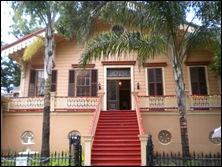
temple The temple, with its traditional New Orleans exterior complete with wrought iron fence, and interior complete with traditional Hindu worship space, is a perfect example of the beauty and strength of our multicultural, pluralistic society. That this temple offers seva in the form of free dinner to the community every Sunday night, only enhances its beauty. New Orleans is a fantastic city, but also a city very much in need of compassionate service.

The space generously provided by the temple for Yogathon was absolutely lovely, with marble floors, dark wood paneling, stained glass accents and images of Indian devotional art. Two instructors, Laura Flora and Anne Compton Lambeth from Wild Lotus Yoga led a class, which was only the start of the evening. Before leading the attendees through gentle asanas (yoga postures), Laura spoke about the deep spiritual art of yoga. We had a very diverse group, some beginners and others experienced, who were all sweetly tolerant of my running to and fro with the camera.

 summer 2010 047  summer 2010 090 

summer 2010 089Laura guided the class through breath awareness and various asanas, emphasizing stretch without strain. She gave simple but accurate explanations for the meaning of the asanas, such as Vrikshsasana “the tree pose.” Anne assisted by gently helping people position and relax into the poses.
The class was transformative; there was a noticeable difference from the slightly harried people arriving in the rain, and the same people one hour later, rising from Shavasana: relaxed, energized and peaceful.

summer 2010 077summer 2010 061 summer 2010 053 summer 2010 056 

summer 2010 040After the yoga class (and taking a moment to rehydrate with some juice!) we were given a tour of the temple and everyone was made welcome to join in chanting during the beautiful religious service. This close encounter with singing, dancing Bhakti tradition was eye-opening for many of the non-Hindu attendees who associate Hinduism with scriptural complexity and meditative contemplation. The Bhakti tradition is especially at home in New Orleans, where music, dance and vibrant celebrations are very much a part of the city’s sense of self. Everyone was pleased to deepen their understanding.

Exploring the diversity of ways to worship in any tradition is a key to understanding the true nature of faith. Here in the United States there are many Hindu communities, each with its own traditions, rites and practices. While much is held in common, every congregation is unique. In turn, there is much that is shared in common with the surrounding culture; each is advised and enriched by the other.

We enjoyed a vegetarian meal lovingly prepared by the temple community, and over this delicious dinner, had an informal but spirited discussion about the roots of yoga and its role in American life. Some people had questions about yoga and Hinduism, so we introduced general history and terms, and discussed the many forms of yoga philosophy. We all shared our views and experiences of the empowering necessity of spiritual expression, regardless of one’s faith (or lack thereof). Everyone I spoke with had a deep respect for the power of yoga as part of an enlightening and grounding spiritual practice.

summer 2010 031 summer 2010 102 summer 2010 103

As this was the 5th Anniversary of Hurricane Katrina, there were events and rallies throughout the city. A few people who attended Yogathon remarked on the connection between healing oneself and healing one’s community, and chose to attend this event as part of their personal observance of this significant date. Many grieve for those who died in that catastrophe, and struggle to come to terms with the forever altered landscape of the survivor. New Orleans has a long way to go: many people are still traumatized by the events set in motion by the hurricane; many are simultaneously seeking and creating a path for revitalizing the city and themselves.

summer 2010 068

Being part of Yogathon and offering yoga as a vehicle to heal this great city (my second home), was very meaningful to me personally. Just as the United States welcomes my hereditary Hindu community and has in turn been enriched by the unique perspectives which that community has to offer, so I feel adopted by New Orleans, and allowed to help in this time of rebirth. It’s humbling that, as someone who is not from this city, I am accepted, guided and embraced by the community, and allowed to make my own small contribution.

I’d like to thank everyone at Hindu American Seva Charities, ISKCON New Orleans, Wild Lotus Yoga, New Orleans Healing Center and Interfaith Works, as well as my eternally tolerant husband Urban Haas, and our lovely NOLA housemate Veronica Leandrez for support, tolerance, hospitality and encouragement far above and beyond the call of duty. My community here in New Orleans together explores and lives the experience of self-healing as community healing. I am so grateful for the opportunity to bring some Hindu wisdom to sustain that journey.

Our experience with Yogathon revealed that there is no need to build bridges between cultures. In simply coming together and sharing of ourselves, we realize that we do not inhabit separate shores, but live a land that is itself a bridge. We only map what is already there.